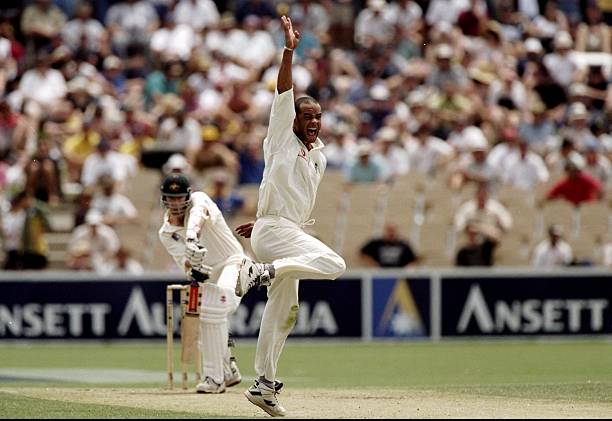
There is no doubting that in his day, Dean Headley was a class act. From a young age, Headley was rubbing shoulders with up and coming overseas and established pros in the Birmingham League. Back then, that was the place to be noticed and put you on the road to the professional game. Headley, speaking recently in the Cricket Paper, reckons that club cricket is not producing the players it should be since the ECB Premier Leagues were introduced and that there is no no clear pathway for aspiring youngsters.
Allowing for the natural tendency to believe that everything was better back in your day, Headley seems to identify the separation of First XI from the rest of their clubs as being at the root of the problem.
The whole idea of Premier Leagues was to replicate Grade Cricket in Australia as being the route to the first class game. That was part of the MacLaurin Report which also recommended getting rid of the clutter of Second XI and Minor Counties Cricket. While the Premier Leagues were introduced, Minor Counties and Second XI cricket remained and the whole purpose of Premier Leagues foundered.
But to say that they do not produce or develop players for the professional game, is with respect to Headley, simply not the case. Headley was richly talented and found himself playing at the sharp end of club cricket in his teens. Much like today. If you are going to have any real prospect of playing in the professional game today, you need to be good enough to be playing Premier League cricket by the age of 15 or 16.
Generally, the path to the professional game involves playing county representational cricket, first class or minor, and getting into a first class county academy. But that is only half the story and most promising youngsters are already embedded in clubs. Where that club is a premier league club, most talented youngsters appear regularly from a young age. In cases where the promising youngster’s club is not a PL club, he will be encouraged to move to a PL club to continue his development.
The path to professionalism is probably no less tortuous today than it was in Headley’s day, maybe a little more so given the various formats of the game that now exist. Discerning a clear “staircase of and to excellence” is not easy. To someone of Headley’s talent, his ascent to stardom probably looks straightforward from today’s perspective. Little wonder then that he thinks it is all much more difficult today.
But club cricket at Premier League level provides a valuable stepping stone and place of learning for aspiring youngsters not to mention a serious proving ground. It is doing a real job. Not perhaps the one it was designed for but that is through no fault of its own, but a real job nonetheless. Long may it continue.
SW







 Sticky Wicket